
 adminkrm
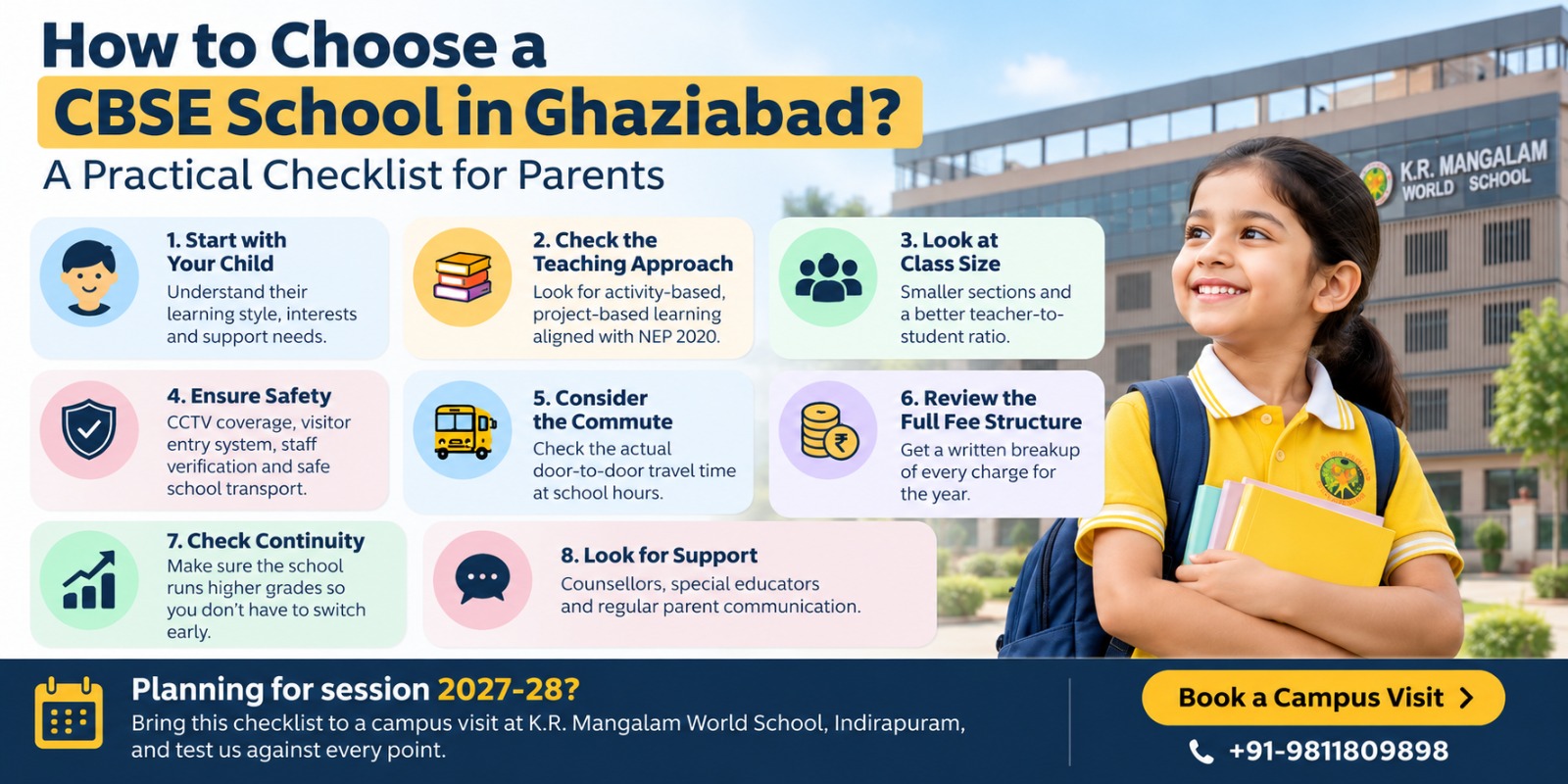
| How to choose a CBSE school in Ghaziabad? – To choose a CBSE school in Ghaziabad, start by listing what your child needs and what your family cannot compromise on. Then compare five things side by side: teaching approach, class size, campus and bus safety, daily commute time, and the full fee breakdown. Visit at least three campuses, ask each one the same questions, and watch how your child responds. |
Picking a CBSE school in Ghaziabad is harder than it looks. Indirapuram alone has dozens of schools within a few kilometres, and almost every one of them promises smart classrooms, strong results, and holistic development. On a brochure, they all look the same.
The real differences show up in details most parents never get around to asking about. How many children sit in one section? Who rides the school bus with your child? What does the fee look like after the first quarter? Can the school keep your child until the board years, or will you be switching again in three years?
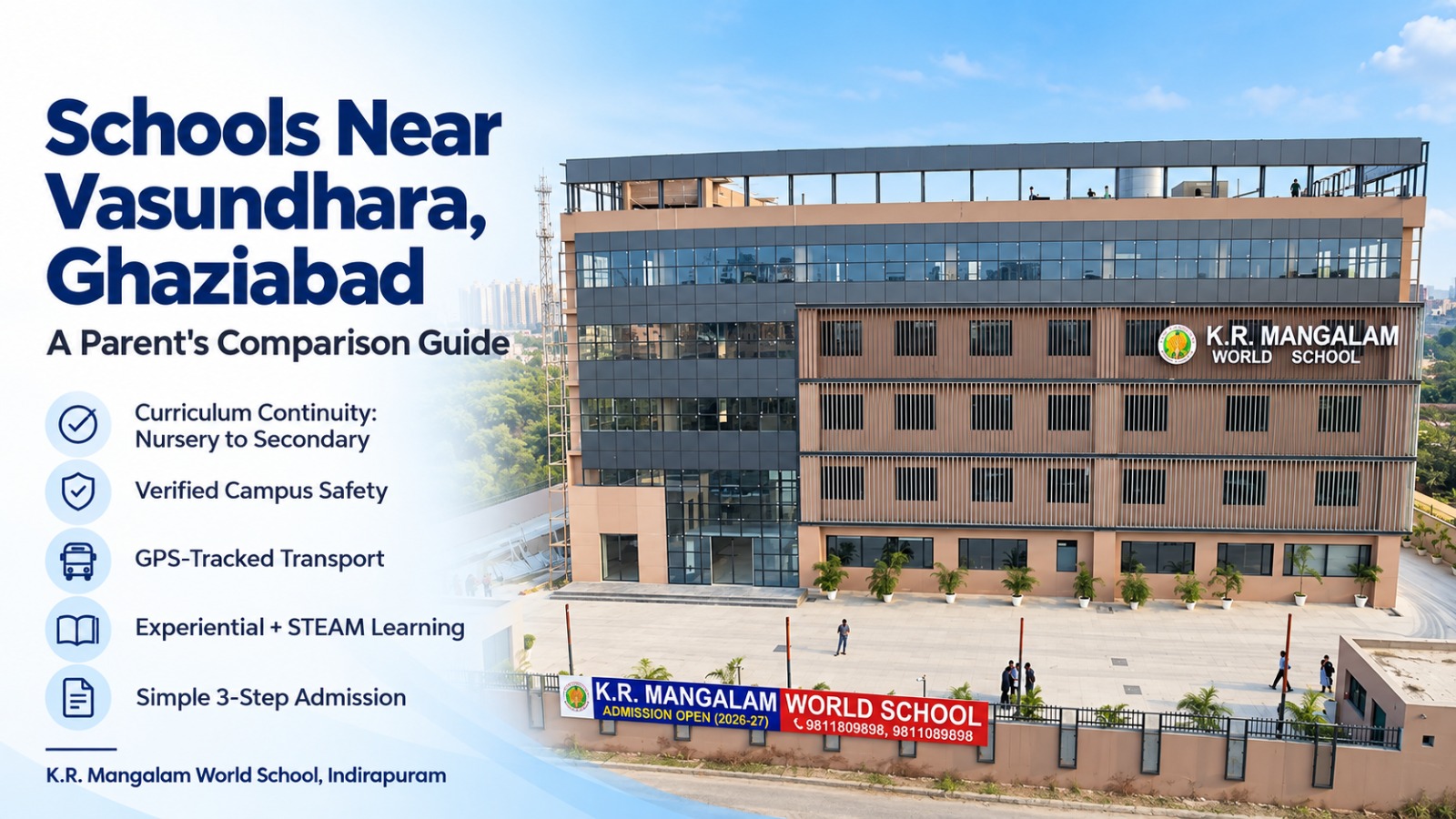
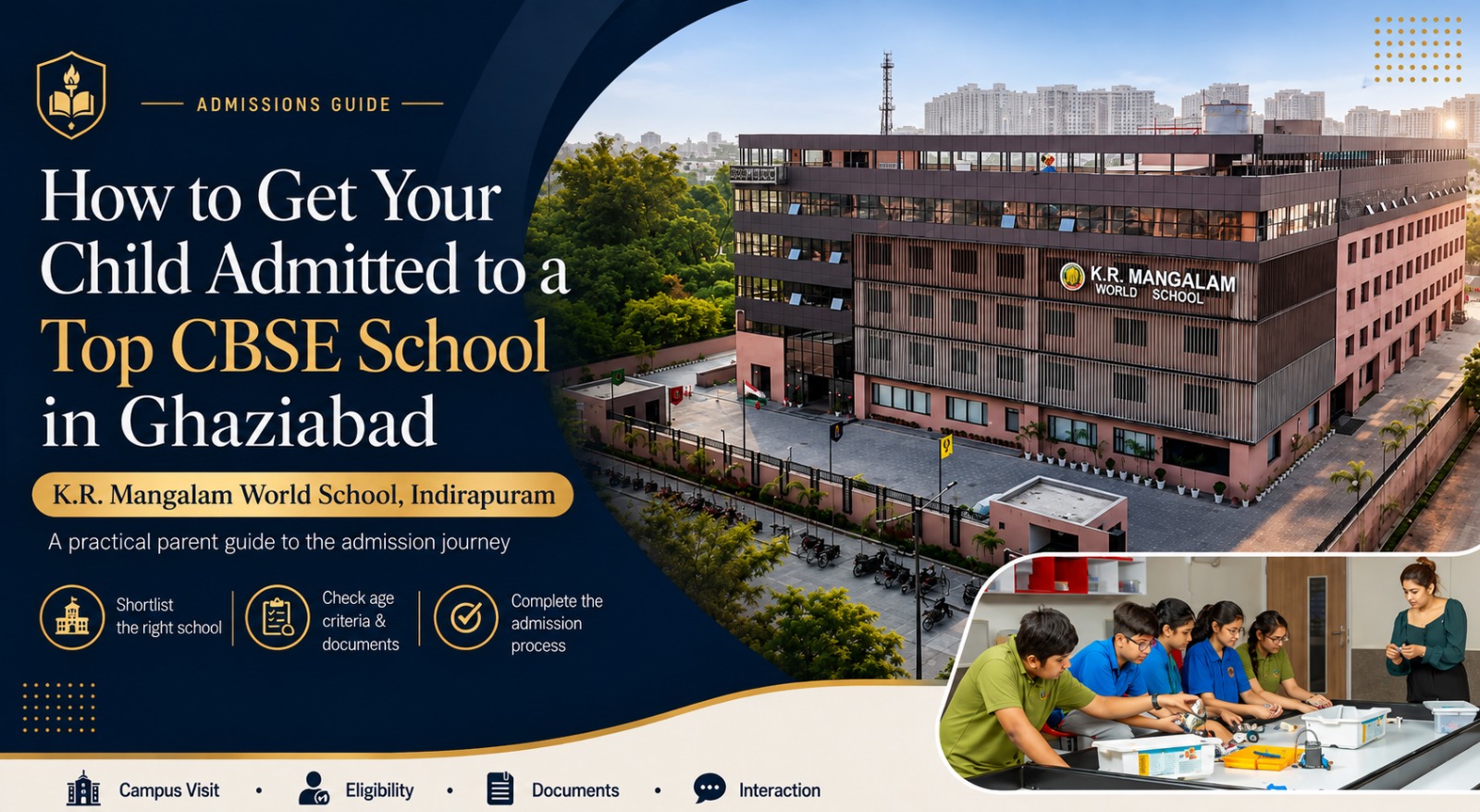
This guide takes you through each of those details, step by step, so you can compare schools on facts instead of first impressions. It is written by the admissions team at K.R. Mangalam World School, Indirapuram, and it is built on the questions parents actually ask us during campus visits.
How to Choose a CBSE School in Ghaziabad: 8 Things to Check
Use this table as your shortlist filter. If a school fails the first two rows, it is not the right fit, however good it looks online.
| Factor | What to check | Red flag |
| Fit for your child | Learning style, support needs and interests your child has | The school cannot explain how it adapts to different learners |
| Safety | CCTV coverage, visitor entry system, staff verification, bus attendant | Anyone can walk in without signing in at the gate |
| Class size | Students per section and teacher-to-student ratio | 40 or more children in one section |
| Teaching approach | Activity and project-based work, alignment with NEP 2020 | Only textbook reading and rote homework |
| Commute | Door-to-door travel time at actual school hours | More than 45 minutes each way for a young child |
| Fees | A written breakdown of every charge for the year | Only the tuition fee is shared upfront |
| Continuity | Grades the school runs now and its plan for higher grades | You may have to switch schools in a few years |
| Support | Counsellors, special educators and regular parent communication | No clear point of contact for parents |
| Planning for session 2027-28? Bring this checklist to a campus visit at K.R. Mangalam World School, Indirapuram, and test us against every row. Book a campus visit or call +91-9811809898. |
Step 1: Start with your child, not the school
Most parents begin with a list of school names. It works better the other way round. Before you open a single school website, write down what your child needs and what your family cannot compromise on. That one page becomes your filter for every school you visit.
- Note how your child learns best. Does your child learn by doing, by listening, by reading, or by talking things through? A school that teaches in only one way will suit only one kind of child.
- List any support your child may need. This could be extra help with reading, a learning difference, speech, or simply settling in after a move to a new city.
- Write down your child’s interests. Sports, music, art, robotics, or languages. Check later that the school timetables these and does not just list them on its website.
- Fix your family’s non-negotiables. Maximum travel time, budget range, and whether you need school transport or after-school daycare.
- Confirm the class and the age cut-off. Note the class your child will join and check the minimum age for it (see the age table later in this guide).
Carry this list on every campus visit. It keeps the conversation focused on your child, not on the school’s brochure.
Step 2: Look at how the school teaches, not only what it teaches
Every CBSE school in Ghaziabad follows the same syllabus. What changes from one school to the next is how that syllabus is taught.
Under the National Education Policy (NEP) 2020, schooling follows a 5+3+3+4 structure: the Foundational stage (ages 3 to 8), the Preparatory stage (ages 8 to 11), the Middle stage (ages 11 to 14) and the Secondary stage (ages 14 to 18). Each stage needs a different style of teaching. A four-year-old learns through play, stories and movement. A twelve-year-old needs projects, experiments and real problems to solve.
During your visit, ask:
- Can I see a class in progress, and not just an empty classroom?
- How much of the week goes into activities, projects and lab work?
- How do you teach a child who learns more slowly, or more quickly, than the rest of the class?
A useful test: ask a teacher to describe a project their class did recently. If they answer with a specific example, the approach is real. If they answer with a slogan, it probably is not.
Step 3: check class size and individual attention
Class size is the single number that tells you how much attention your child will get. In 40 minutes with 40 children, a teacher has about one minute per child. Bring that section down to 25 and each child’s share of the teacher’s time goes up by more than half.
Ask these questions:
- What is the maximum number of students in one section?
- What is the teacher-to-student ratio for the school as a whole?
- Is there an assistant teacher in the pre-primary classes?
- How do teachers track each child’s progress, and how often is it shared with parents?
Step 4: Check safety on campus and on the school bus
Safety is not a nice-to-have. In 2017, CBSE made schools solely responsible for the safety of children on campus. Its circular directed affiliated schools to keep working CCTV cameras at vulnerable points, control visitor entry, carry out police verification of staff, and conduct regular safety audits. For school transport, CBSE guidelines require GPS and CCTV in buses, speed governors limited to 40 km/h, and a trained lady attendant on board.
Here is what to check in person:
- How visitors enter: is there a register or digital visitor system at the gate?
- CCTV coverage across corridors, entry points, and school buses.
- Background verification of drivers, helpers and support staff.
- A female attendant on every school bus.
- A trained nurse or medical room on campus during school hours.
- How often fire drills and safety audits happen.
Ask to see these systems, not just hear about them. A school that is serious about safety will happily show you.
Step 5: Be realistic about the daily commute
Ghaziabad traffic changes the maths of school choice. A school that is 8 km away can take 15 minutes on a Sunday and 45 minutes at 7:30 am on a weekday.
For children in Nursery to Grade II, a commute of under 30 minutes each way is a sensible rule of thumb. Long bus rides mean earlier wake-ups, tired evenings and less time for play, homework and sleep.
Before you apply:
- Do a trial run at real school timings, from your society gate to the school gate.
- Ask whether the school bus covers your society and where the nearest stop is.
- Ask what time the first pickup on your route happens. Bus routes are usually fixed at the start of the session, so confirm early.
Step 6: Ask for the full fee breakup in writing
Fees at CBSE schools in Ghaziabad vary widely. Published school listings show annual fees ranging from roughly ₹30,000 to more than ₹2.5 lakh, depending on the school, the class, and the facilities on offer. The tuition fee is only one part of what you will pay. Ask for every line item:
| Fee component | What to ask |
| One-time admission fee | Is any part of it refundable if you withdraw? |
| Caution or security deposit | Is it refunded when your child leaves, and how? |
| Tuition fee | Is it paid monthly, quarterly,y or yearly? How much has it gone up in the last three years? |
| Transport | Is it charged by distance or as a flat rate? |
| Books, uniform and activities | Are these included in the fee or charged separately? |
| Meals and daycare | Are they optional or compulsory? |
A school that hands you a clear written breakdown on the first visit is usually a school that stays transparent later too.
Step 7: choose a school that can grow with your child
Changing schools midway is hard on children. They lose friends, routines, and teachers who understand them. Ask:
- Up to which grade does the school run today?
- What is the plan for the higher grades?
- When does career counselling begin? It should start well before stream selection, not after it.
Step 8: Look beyond marks
Board results matter, but from Nursery to Grade VIII they tell you very little about your child’s day-to-day experience. Look at what fills the rest of the timetable:
- Outdoor and indoor sports, with trained coaches.
- Art, music, dance and theatre as timetabled subjects, not occasional events.
- STEAM, robotics and coding, with hands-on labs.
- A third or foreign language option.
- Counsellors and special educators for children who learn differently.
- Leadership roles and community service.
Step 9: Check how the school works with parents
Your child spends six to seven hours a day at school. You should know what happens in those hours without having to chase anyone for updates. A good school treats parents as partners, not as visitors at the annual function.
Here is how to check it:
- Ask how often parent-teacher meetings happen, and whether you can request one in between.
- Ask how updates reach you: newsletters, circulars, an app, or a parent portal.
- Ask who your single point of contact is for admissions, academics,s and transport.
- Ask how a concern or complaint is handled, and how quickly you will hear back.
- Ask how parents are involved in workshops, events and school committees.
If the answers are vague, expect the communication to be vague too.
Step 10: Visit the campus with your child
You can learn more in a 45-minute visit than from any website. Go on a regular school day, take your child along and watch how they react. Children often sense a good fit faster than adults do. Notice how staff speak to students in the corridors, whether classrooms feel calm or chaotic, and whether your questions get clear, specific answers.
What is the right age for school admission in Ghaziabad?
Most CBSE schools in Ghaziabad follow age criteria aligned with NEP 2020, where Grade I begins at age 6. The usual pattern looks like this:
| Class | Minimum age |
| Nursery | 3 years |
| LKG | 4 years |
| UKG | 5 years |
| Grade I | 6 years |
The cut-off date for calculating age differs from school to school. At K.R. Mangalam World School, Indirapuram, age is counted as of 31 July of the admission year. Always confirm the cut-off with each school before you apply.
Common mistakes parents make when choosing a CBSE school in Ghaziabad
- Choosing on brand name alone. A well-known name tells you nothing about class size, the bus route, or the teacher your child will get.
- Judging the school by its building. A grand facade does not guarantee good teaching. Ask what happens inside the classroom.
- Ignoring the commute. An extra 30 minutes each way adds up to hours every week.
- Comparing only tuition fees. Transport, books, activities, and annual charges can change the real cost a lot.
- Leaving the child out of the visit. Your child’s comfort on campus is a real signal. Use it.
- Starting too late. Many schools in Ghaziabad begin admissions for the next session between October and January, and nursery seats tend to fill first.
How K.R. Mangalam World School, Indirapuram meets this checklist
We share this checklist because we would rather you compare us properly than choose us from a brochure. Here is how our Indirapuram campus answers each point:
| What parents check | At KRM Indirapuram |
| Board and curriculum | CBSE from the Foundational stage through the Secondary stage, fully aligned with NEP 2020 |
| Class size | Maximum 25 students per class, with a teacher-to-student ratio of 1:15 |
| Campus safety | 230 CCTV cameras, a trained security team, a visitor management system, regular drills and safety audits |
| School bus | Own fleet of air-conditioned, GPS-enabled buses with a female safety warden on every bus |
| Teaching approach | Experiential learning, project-based learning, STEAM and a multiple intelligences approach |
| Labs and studios | AC classrooms with Smart Boards, separate Physics, Chemistry and Biology labs, a STEAM studio with 3D printers, and a robotics and AI lab |
| Beyond academics | Football, basketball, cricket, athletics, chess, skating, music, dance and theatre; French, Spanish and German from Grade V |
| Student support | A Student Support Team with special educators and counsellors; career counselling from Grade VIII |
| Parent partnership | Regular newsletters, circulars and parent-teacher meetings, a dedicated admission counsellor and a structured grievance redressal process |
| For working parents | After-school daycare on campus and a trained nurse during school hours |
| Recognition | Ranked No. 1 in Ghaziabad, Challengers Category, New Ghaziabad Zone, Jagran School Ranking 2025-26 |
| Experience | Part of the K.R. Mangalam Group, with 20+ years in education and 15,000+ students across its schools |
Admission at KRM Indirapuram in three simple steps
- Submit an enquiry through our online admission form. You will receive a link to the full application.
- Visit the campus. Children from Nursery to Grade V have a friendly conversation with the school head. No tests, no pressure. Applicants for Grades VI and VII also take a short English and Mathematics assessment.
- Confirm the seat by submitting documents and paying the fee. Our admission counsellor stays your point of contact throughout.
Mid-session admissions are considered, subject to seat availability. See the full admission procedure and fee structure for details.
Key takeaways
- Start with your child’s needs and your family’s non-negotiables before you look at any school.
- Compare schools on class size, safety, teaching approach, commute, and the full fee breakdown.
- For young children, keep the one-way commute under about 30 minutes.
- Ask for every fee component in writing, not just the tuition fee.
- Pick a school that can take your child through to the Secondary stage, so you avoid a midway switch.
- Check how the school communicates with parents, not just how it teaches children.
- Visit at least three campuses with your child and ask each one the same 12 questions.
- Start early, because many schools in Ghaziabad open admissions between October and January.
Frequently asked questions about choosing a CBSE school in Ghaziabad
Which CBSE school in Ghaziabad is the best?
There is no single best CBSE school in Ghaziabad for every child. The best school for your family is one that teaches the CBSE curriculum well, keeps children safe, is within a reasonable commute, and suits how your child learns. Independent rankings, such as the Jagran School Ranking, are a useful starting point. After that, shortlist three schools and visit each one with your child.
Which school is better in Ghaziabad?
The better school is the one that fits your child, not the one with the biggest name. Compare schools on five things you can check yourself: fit for your child, class size, safety systems, daily commute, and a written fee breakup. A school that does well on all five, and where your child feels at ease during a campus visit, is the better choice for your family.
Which school is better for CBSE?
The better school for CBSE is one that teaches the syllabus through activities, projects, and labs, not only textbooks. Look for NEP 2020-aligned teaching across the Foundational, Preparatory, Middle, and Secondary stages, small class sizes, and continuity up to the board years, so your child does not have to change schools midway.
What are the top 20 schools in Ghaziabad?
There is no single official list of the top 20 schools in Ghaziabad. Surveys such as the Jagran School Ranking and the Times School Survey rank schools by zone and category, so the list changes with the source and the year. Use these rankings to build a shortlist, then test each school against the checklist in this guide. K.R. Mangalam World School, Indirapuram is ranked No. 1 in Ghaziabad in the Challengers Category, New Ghaziabad Zone, Jagran School Ranking 2025-26.
What is the right age for nursery admission in Ghaziabad?
Most CBSE schools in Ghaziabad admit children to Nursery at 3 years, LKG at 4, UKG at 5, and Grade I at 6. The date used to calculate age varies by school. At K.R. Mangalam World School, Indirapuram, age is counted as of 31 July of the admission year.
When do school admissions start in Ghaziabad?
Many private CBSE schools in Ghaziabad begin admissions for the next academic session between October and January, and the new session usually starts in April. Nursery seats tend to fill first, so it helps to start shortlisting and visiting schools early.
What is the average fee of a CBSE school in Ghaziabad?
Fees vary widely. Published listings show annual fees from roughly ₹30,000 to more than ₹2.5 lakh, depending on the school, class, and facilities. Always ask for a written breakdown that covers the admission fee, deposit, tuition, transport, and any other charges, so you can compare the true yearly cost.
What documents are needed for school admission in Ghaziabad?
Most schools ask for the child’s birth certificate, passport-size photos of the child and both parents, address proof, Aadhaar cards of the parents, and a medical certificate. From Grade II onwards, you will usually also need a transfer certificate and the last two report cards. Check the exact list with each school.
Is a school near home better than a bigger school farther away?
For young children, usually yes. A shorter commute means more sleep, less fatigue, and easier parent involvement. A school within a 30-minute ride that meets your checklist is often a better choice than a bigger name that needs an hour each way.
Is CBSE a good board for my child?
CBSE is a national board recognised across India, which helps families who may relocate. Its NCERT-based syllabus is also closely aligned with national entrance exams such as JEE and NEET. With NEP 2020, CBSE schools are also moving towards more activity-based and skill-based learning.
Can I get admission in a CBSE school in Ghaziabad in the middle of the session?
Yes. Many schools accept mid-session admissions, subject to seat availability in the class. At K.R. Mangalam World School, Indirapuram, mid-session applications are considered based on the seats available.
Summary
| Choosing a CBSE school in Ghaziabad comes down to a few checkable facts: a clear fit with your child’s needs, a safe campus and transport, small class sizes, a teaching approach that suits your child, a manageable commute and a transparent fee structure. Start with your child’s needs, ask every school the same questions, check how it works with parents, and visit with your child before you decide. Starting the process between October and January gives you the widest choice of seats. |
Conclusion
Choosing a CBSE school in Ghaziabad gets much easier once you stop comparing brochures and start comparing facts. Start with your child, count the children in a section, ride the bus route in your head, ask for the full fee in writing, and trust what you see on a normal school day.
If K.R. Mangalam World School, Indirapuram is on your shortlist, come and test us against this checklist. Sit in on a class, look at the safety systems, ask every question on the list, and see how your child feels on campus.
| Book your campus visit for session 2027-28
Call +91-9811809898 | Email Indirapuram@krmangalam.com | Submit an admission enquiry K.R. Mangalam World School, Nyay Khand-1, Indirapuram, Ghaziabad, Uttar Pradesh 201014 |