
 adminkrm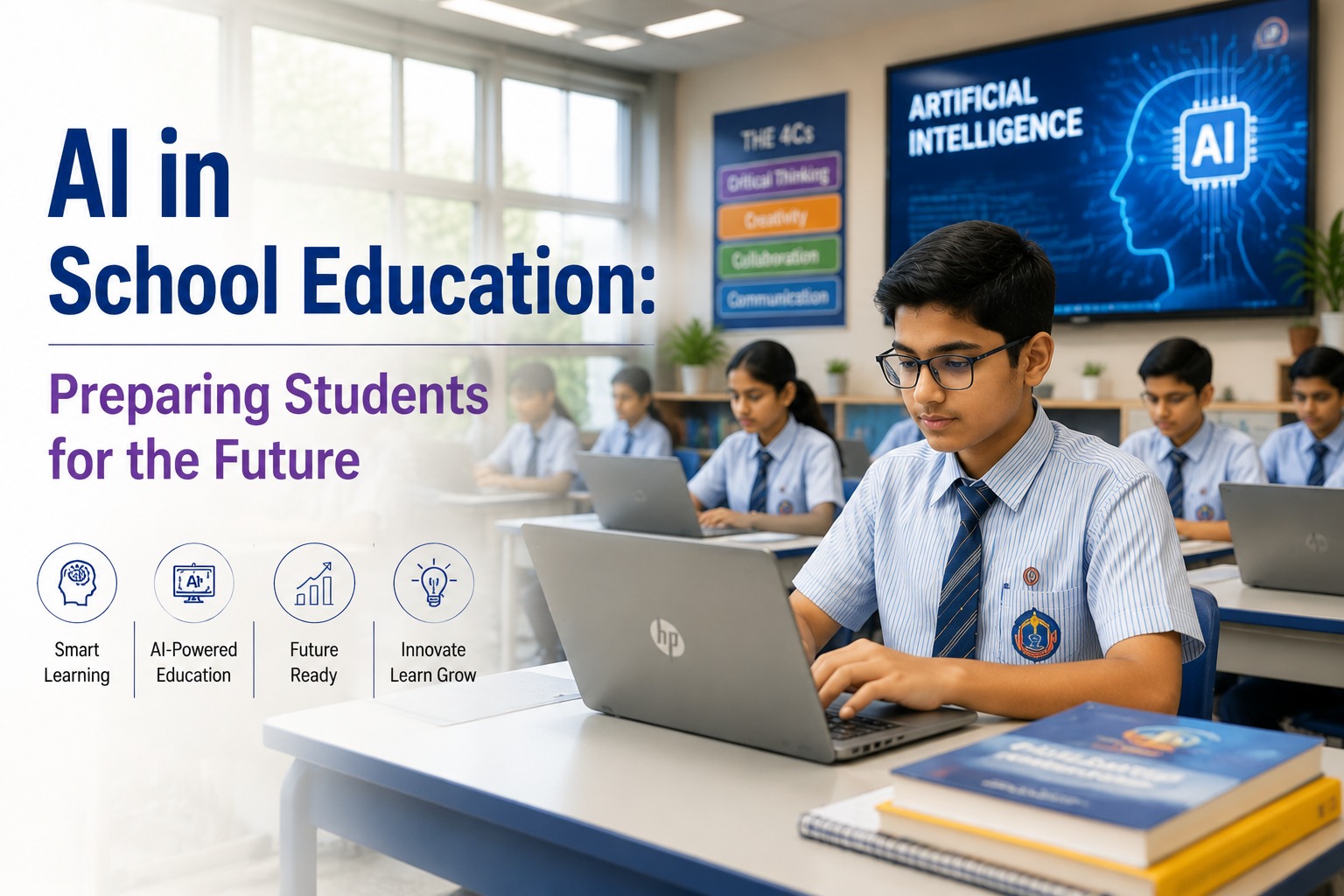
A lot of parents ask the same question during admission season: is my child being taught for today’s classroom, or for the world they’ll actually work in? That question comes up more often now because AI in school education isn’t some future possibility. It’s already shaping how students research topics, practice math, and get feedback on their writing. For parents, this shift can feel confusing. Should children use AI tools at all? Will it make them lazy, or help them learn faster? Understanding what AI actually does in a classroom, and what it doesn’t do, is the first step to answering that with confidence instead of worry.
AI in School Education: Understanding the Changing Learning Landscape
In simple terms, AI in school education means software that adapts to how a student learns, instead of teaching everyone at the same pace. A student struggling with fractions gets more practice on fractions. A student who’s ahead moves to harder questions without waiting for the rest of the class.
This use of technology in education shows up in practical ways in Indian classrooms: adaptive apps that adjust question difficulty, writing tools that flag grammar before a teacher checks the final work, and smart boards that generate quiz questions during a lesson. None of it replaces the syllabus. It fills gaps one teacher managing thirty students can’t cover for every child.
How Artificial Intelligence Is Helping Students Learn Better
The clearest benefit is faster feedback. A child’s essay used to sit with a teacher for days before corrections came back. AI learning tools for children now flag weak arguments or unclear sentences within minutes, so students can revise while the topic is still fresh, though a teacher still judges tone and depth.
Adaptive platforms do the same for math and science: a student who keeps missing a type of question gets more of those instead of moving on blindly.
AI tools also help with research, letting students explore a topic from different angles. Used well, this builds curiosity. Used carelessly, it becomes copying answers without understanding them, which is why schools need clear usage guidelines.
Why Teachers Will Continue to Play an Important Role
None of this makes teachers less important. If anything, their role is shifting toward what AI genuinely cannot do.
A tool can flag a weak argument in an essay. It cannot notice that a usually cheerful child has gone quiet for a week, or that a student is capable of more than their marks suggest. Teachers notice this because they know the child, not just the scores. Mentoring, resolving conflicts, building a shy student’s confidence, these are relationships, not data points.
The realistic picture for 2026 isn’t AI versus teachers. It’s AI handling repetitive tasks like grading quizzes, which frees up teacher time for discussion, encouragement, and the judgment calls only someone who knows the student can make.
Skills Students Need in an AI-Driven Future
If AI can generate an answer in seconds, memorising facts stops being the most valuable skill a child can have. What matters more is knowing which questions to ask, and whether an answer actually makes sense.
A few skills stand out as genuinely future-relevant: critical thinking, to judge whether an AI answer is accurate; creativity, since original thinking is still something machines imitate; clear communication; collaboration, since real work happens in teams, not alone with a chatbot; and digital awareness of what these tools are good at and where they fail.
These are the skills students need for the future well beyond exams, giving a child who thinks critically and communicates clearly an advantage in almost any career path.
How Parents Can Prepare Children for the Future of Education
Parents often ask what they should do at home, beyond hoping school covers it. A few things genuinely help.
Encourage questions over quick answers. When a child uses an AI tool for homework, ask them to explain the answer in their own words. If they can’t, they’ve copied it rather than learned it.
Set clear boundaries around screen time, especially for younger children, where unsupervised AI chatbot use isn’t appropriate. Talk openly about what these tools can and can’t be trusted for.
Make space for creativity away from screens too: reading, building things, sports, unstructured play. These aren’t distractions from a tech-driven future, they’re exactly what keeps a child’s thinking flexible.
How Schools Are Creating Future-Ready Learning Environments
Schools that take AI in school education seriously aren’t necessarily the ones with the most devices in the classroom. It’s more about how digital learning in schools fits into the broader learning experience, alongside hands-on projects, sports, and activities that build character.
K.R. Mangalam World School, Indirapuram is one example of a school approaching this balance deliberately, combining technology-supported learning with experiential activities and a consistent focus on all-round development rather than academics alone. The goal isn’t to chase every new tool available, but to use technology where it genuinely helps a child learn, while keeping the parts of a modern education system that depend on human interaction firmly in place.
Frequently Asked Questions
Q1. How is AI changing school education?
AI in school education mainly changes how students get feedback and practice, not what they’re taught. Tools adapt questions to a student’s level, mark objective work instantly, and help teachers with tasks like generating practice sheets, keeping lessons closer to each student’s own pace.
Q2. Is AI safe for children?
AI can be safe for children when schools set clear guidelines and supervise its use. Risks mostly come from unsupervised access to AI chatbots for young children. Age-appropriate tools, teacher oversight, and open conversations at home make the biggest difference.
Q3. Will AI replace teachers in schools?
No. AI can handle repetitive tasks like grading quizzes or generating practice questions, but it cannot mentor a struggling student, notice emotional changes, or build the trust a teacher earns over time. Teachers remain essential for the human, judgment-based parts of education.
Q4. How can parents prepare children for an AI-driven future?
Parents can encourage critical thinking by asking children to explain AI-generated answers in their own words, set reasonable screen-time boundaries, and make space for creativity through reading, sports, and play. Talking openly about how AI tools work builds healthier habits.
Conclusion
AI in school education isn’t something parents need to fear or chase blindly. Used well, it personalises feedback, speeds up practice, and frees teachers to focus on mentoring rather than repetitive grading. Used carelessly, it can shortcut real learning. The schools and parents who get this right won’t be the ones with the most technology, but the ones who use it thoughtfully, while making sure children still learn to think, question, and create on their own.